Saltar la navegación

Intonation and accentuation in English


Intonation

Intonation is the rise and fall of the pitch of our voices, it plays a crucial role in how we express meaning. Wells (2006) affirms that intonation is “the melody of speech” (p. 1).

Intonation is produced by variations in the pitch of the voice, intonation is represented with arrow symbols in the following categories:

  • Level (➙)
  • Falling (↘)
  • Rising (↗)
  • Fall-rising (↘↗)
  • Rise-falling (↗↘)

Intonation has a gramatical function that varies depending on the type of sentence.

1. Falling intonation is used in declarative statementes, wh-questions, imperatives and explanations.

“When is your birthday?” is an example of falling intonation (↘).

2. Rising intonation is used in closed yes-no questions.  It can also be used to express surprise. 

“Are you hungry?” is an example of rising intonation (↗)

"Really?" is another example of rising intonation (↗)

Without visual support, intonation allow us to recognize a person’s fellings; if they are sad, happy, angry...

Intonation is very important in all languages, conveying emotions, emphasis, and intended meaning.

References 

Wells, J. C. (2006). English intonation: an introduction. https://pdfcoffee.com/english-intonation-7-pdf-free.html
Example of intonation in Friends

com/watch?v=JjpnslsuA2g

Word and sentence stress

"the act of emphasizing a particular feature of something or making something more noticeable" 

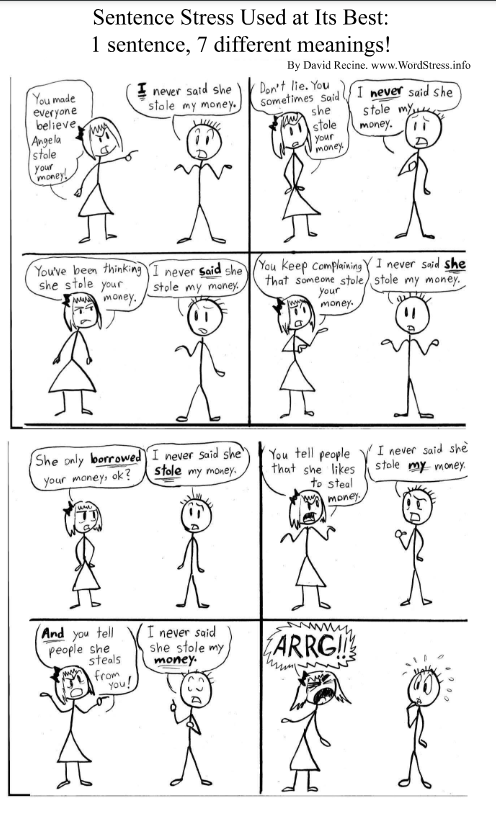
Stress placement can completely change the meaning of a sentence. Štěpánek (2017) points out that native English speakers control word prominence according to the meaning they want to convey in a sentence.

A simple sentence like "I'd like a cup of American coffee" can have several interpretations depending on which word the speaker emphasizes. Firstly, if the emphasis is placed on the last word "coffee", the sentence would be a simple request. On the other hand, if the emphasis is placed on "American", the message conveyed by the sentence is that it is an American coffee and not another type of coffee. Finally, if the emphasis is placed on "cup", it means that he wants a cup, not another type of container like a mug.

"I'd like a cup of American coffee"
I'd like a cup of American 'coffee Simple request
I'd like a cup of 'American coffee He or she specifically wants an American coffee (not a different type of coffee like a latte)
I'd like a 'cup of American coffee That person wants a cup, not a different type of container like a mug.

References

accentuation. (2024). https://dictionary.cambridge.org/dictionary/english/accentuation

Štěpánek, B. P. (2017). Innovative activities for teenagers’ pronunciation skill development [Tesis de maestria, Universidad Masarykiana Brunensis]. https://is.muni.cz/th/b678s/DT_000_Text_-_10b_Xf_Y_E_odevzdano_Archive.pdf


Example stress timing

Stress timing plays a crucial role in clear communication.

The way you emphasize words in a sentence can completely change its meaning.

Take a look at the sentence below, and we'll explore this with different stresses:

Simple request: 

I asked you to buy me a bunch of red roses


I asked you to buy me a bunch of red roses. 

This sentence means that I asked specifically you to buy the roses and not someone else.

I asked you to buy me a bunch of red roses

This sentence implies that I specifically asked for red roses, not any other colour like white or black roses. 

I asked you to buy me a bunch of red roses

This sentence connotation is that I asked for roses, not other type of flowers like tulips, lilies or sunflowers.


References

English sentence stress. (s. f.). TeachingEnglish. https://www.teachingenglish.org.uk/professional-development/teachers/knowing-subject/articles/english-sentence-stress

Sentence Stress Use: 1sentence, 7 different meanings! (s. f.). wordstress.io. https://www.wordstress.info/word-stress/sentence-stress/

Press the following link to go to intonation and stress activities: LINK

Creado con eXeLearning (Ventana nueva)